
How to Practice Tennis Alone: 7 Tips for Adult Recreational Tennis Players
Your tennis partner canceled? Don't cancel your practice. Here are seven ways busy adult players can improve their game solo.
It can be difficult for adult recreational tennis players to find time to practice. Between work, family, social activities, and everything else going on in life, finding a tennis partner with a similar schedule isn’t always easy. And even when you do find someone to hit with, there are times when they have to cancel at the last minute.
So, what do you do when you want to practice tennis but don’t have a partner available?
The good news is that you don’t always need someone on the other side of the court. Practicing tennis alone can be a great way to work on specific parts of your game and make the most of the limited time you have available.
Tennis isn’t an easy sport to master. There are so many different shots and techniques to learn, including the forehand, backhand, volley, slice, drop shot, and serve, just to name a few. For adult recreational players who may only have a limited amount of time to dedicate to tennis each week, making every practice session count is especially important.
Here are seven ways to practice tennis alone and improve your game.
1. Get a Ball Hopper and Plenty of Tennis Balls
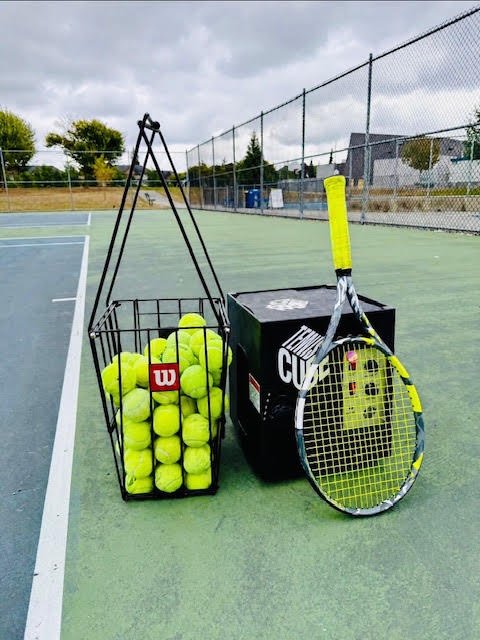
If you want to improve your tennis, you need to hit plenty of balls. That’s why buying a ball hopper and having a good supply of tennis balls can be one of the best investments you make for your game. Having plenty of balls means you can spend more time practicing your shots and less time bending over to pick them up. Trust me, if you spend more time collecting balls than actually hitting them, your practice session isn’t going to feel very productive. A ball hopper is especially useful for practicing your serve.
The serve is probably one of the most difficult shots in tennis to master, and I’m still working on mine. But the only way to improve is through repetition. From the ball toss and racket preparation to pronation, contact, and follow-through, repeating these movements helps you become more comfortable with the technique. For adult recreational players with busy schedules, even a focused 30–60 minute session can be productive. Instead of trying to practice everything at once, choose one or two specific areas to work on and make those the focus of your session.
2. Invest in a Tennis Ball Machine
Another great option for practicing tennis alone is a tennis ball machine. I personally have a tennis ball machine, and I think it’s a smart investment for anyone who plays regularly. It allows you to hit a large number of groundstrokes while also working on your footwork and movement between shots. You can practice your forehand, backhand, consistency, and positioning without relying on another person to feed you the ball. In an hour of practice, you can get hundreds of repetitions that would be difficult to achieve during a normal hitting session. Tennis ball machines can vary significantly in price. Basic models may simply feed balls at a consistent speed, while more advanced machines can change the speed, angle, frequency, and spin of the shots. Some machines can even be programmed to deliver different types of shots and patterns, allowing you to practice situations that are closer to what you might experience during a match.
For busy adult tennis players, a ball machine can be particularly useful. You can show up at the court, set it up, and start practicing without having to coordinate your schedule with someone else.
3. Find a Tennis Practice Wall
A wall can be a very effective way to practice tennis without a partner. You can work on your forehand and backhand while focusing on timing, consistency, control, and preparation. You can also move closer to the wall to practice your volleys. Try setting yourself a few goals during your session. For example, see how many consecutive forehands or backhands you can hit without making an error.
For recreational players, practicing against a wall can be both productive and fun, especially when you’re looking for a way to get some extra hitting time without needing a partner.
4. Add Cardio and Tennis Conditioning
Tennis is also a great fitness activity, and improving your conditioning can have a noticeable impact on your game. During a tennis match, you’re constantly moving, stopping, changing direction, and recovering between points. Good fitness can help you stay competitive and maintain your level of play even when you’re getting tired.
You can incorporate exercises such as:
- Jogging
- Short-distance sprints
- High knees
- Butt kicks
- Lunges
- Side shuffles
- Interval running
These exercises can help improve your stamina, endurance, speed, and explosiveness. You don’t need to spend hours in the gym. Even 15–20 minutes of focused, tennis-specific conditioning can be a useful addition to your training routine.
5. Improve Your Footwork With Ladder Drills
Good tennis starts with good footwork. You can have a great forehand, but if you can’t get into the right position to hit the ball, you’re going to struggle. Agility ladder drills are a simple way to work on your footwork. They can help improve your balance, coordination, reaction time, and body control, allowing you to move more efficiently around the court. You can practice different patterns, including two-feet-in movements, lateral movements, and quick forward-and-backward steps. You can also combine ladder drills with short sprints to simulate some of the quick movements required during a tennis match.
For adult recreational tennis players, better footwork can help you reach more balls, recover faster between shots, and get into a better position to hit your next shot.
6. Practice Shadow Swings
For beginners, shadow swings might seem a little strange. After all, you’re swinging your racket without actually hitting a ball. However, shadow swings can be an effective way to practice your tennis strokes. You can work on your forehand, backhand, volleys, and serve while focusing entirely on your movement. Pay attention to your preparation, swing path, weight transfer, contact point, and follow-through. Shadow swings can be especially useful when you’re trying to make a technical change to your game. Since you don’t have to worry about where the ball is going, you can focus entirely on the movement and repeat it until it feels smooth and natural. You can even practice your swings at home, making shadow swings an easy addition to your tennis training routine.
7. Film Yourself and Review Your Technique
One of the most underrated ways to practice tennis alone is to film yourself. When you’re playing, it can be difficult to know exactly what your technique looks like. You might feel like you’re getting into the right position or following through correctly, but watching yourself on video can reveal things you didn’t notice while playing. Set up your smartphone behind the baseline and record part of your practice session. Afterwards, watch the footage and look for areas you can improve. If you work with a tennis coach, you can also send them your practice videos and ask for feedback. This can be particularly useful when you’re practicing alone because you don’t have a hitting partner who can give you immediate feedback.
Make the Most of Your Adult Recreational Tennis Practice
Not every adult recreational tennis player has a practice partner available for every session. But that doesn’t mean you have to stop practicing. Solo practice can be a great complement to your regular hitting sessions and recreational matches. Whether you’re working on your serve with a ball hopper, hitting against a wall, using a tennis ball machine, improving your footwork, or practicing shadow swings, there are plenty of ways to improve your game on your own. The key is consistency. You don’t need to spend hours on the court every day. Even 30–60 minutes of focused practice can be valuable when you have a specific goal and make the most of your time.
One of the great things about adult recreational tennis is that you don’t have to be a professional player to keep improving. Whether you’re a beginner, a weekend player, or someone who participates in recreational leagues, there is always something new to work on. So the next time your tennis partner pulls a no-show, don’t pull a no-show yourself. Grab your racket, grab some balls, and put in the work. Your future self and your tennis game will thank you.